
Protecting SAE ORB ports
The straight-thread port with O-ring that seals pumps, valves and manifolds — and how to protect open ports during service and storage.
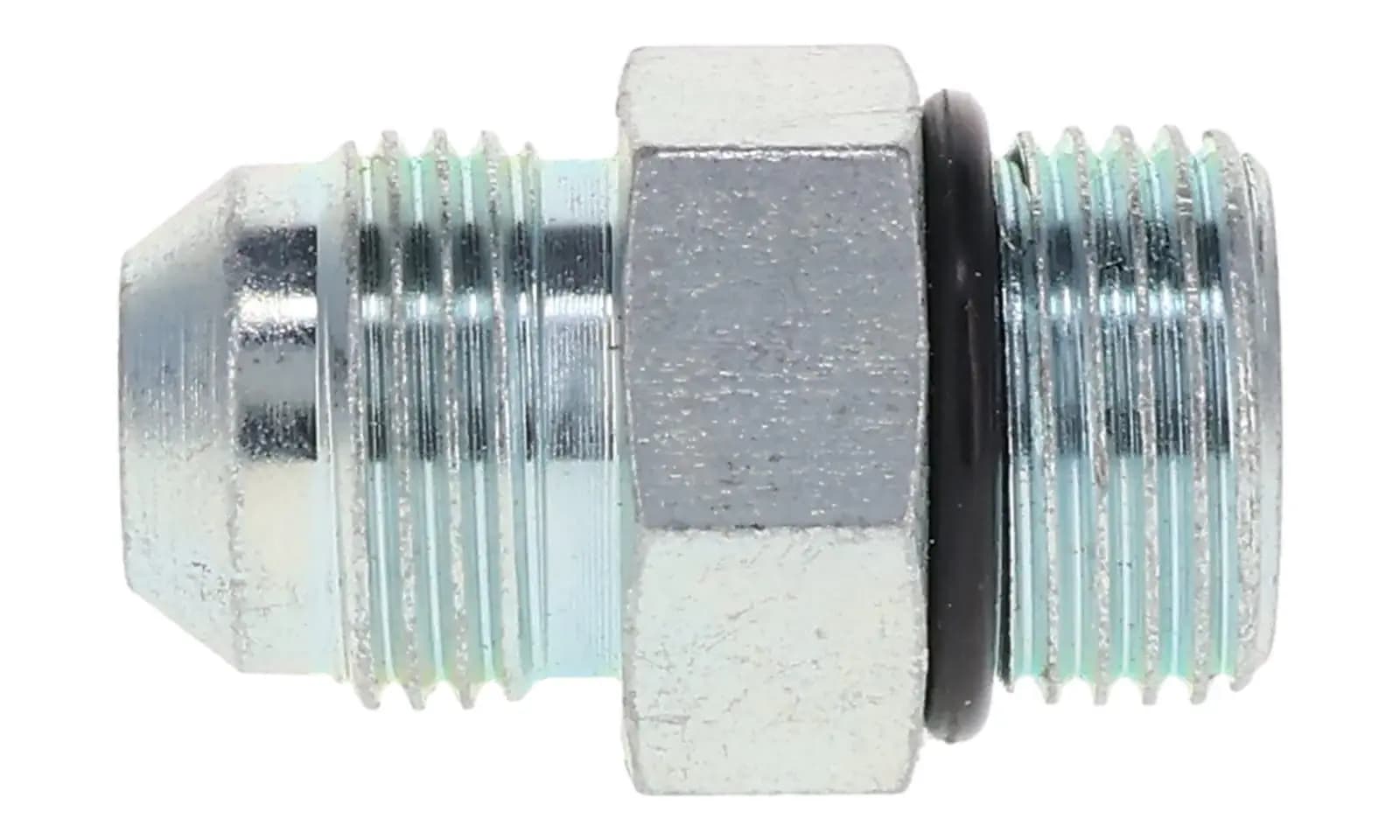
SAE ORB is the port connection you find on the component itself: the pump, the valve, the motor or the manifold. It seals with an O-ring at the shoulder of a straight thread, so the port face and the O-ring determine the seal. Because these ports lie open as soon as a component is disconnected, ORB protection does two things: it keeps contamination out and limits oil loss during service.
What is an SAE ORB connection?
SAE ORB connections, defined in SAE J1926, are used as port connections on hydraulic manifolds, pumps, valves and cylinders. The straight thread holds the fitting, while an O-ring at the shoulder seals against the port face. Unlike tapered threads, the thread does not seal: the O-ring and the port face keep the connection tight.
How it seals
- Straight UNF thread for the mechanical connection
- O-ring at the fitting shoulder
- Seals against a machined port face
- Reliable, service-friendly port sealing
Where SAE ORB ports are used
ORB is the standard way to seal a port on a hydraulic component and therefore appears everywhere those parts are installed. On pumps and motors it forms the suction and pressure ports. On directional and control valves it is the manifold and block connection. On cylinders it is the cap-end and rod-end ports, and on industrial power units it connects the manifolds.
How to check this is your application: if you are sealing a threaded port on a pump, valve or manifold with an O-ring at the shoulder, then ORB protection is the right family. For service and maintenance, choose plugs that also limit oil loss.
What the protection must cover
ORB protection covers the port thread and O-ring seat and closes off the open port during service. The risks it protects against:
- Contamination: dirt and moisture entering an open port
- Oil loss: fluid draining from a disconnected component
- Thread and face damage: knocks that damage the port face or the thread
- O-ring damage: the seal damaged or displaced before assembly
SAE ORB at a glance
| Characteristic | Value |
|---|---|
| Standard | SAE J1926 / ISO 11926 |
| Thread | Straight UNF thread |
| Seal | O-ring at the fitting shoulder, against the port face |
| Role | Port connection on components |
| Sizes | Dash -2 to -24 |
| Region | Worldwide, SAE component practice |
Does this protection suit your application?
Before ordering, check that ORB protection matches your situation:
- Connection: straight-thread port with O-ring at the shoulder
- Size: port thread or dash size known and matching
- Priority: keeping ports clean and limiting oil loss during service
- Medium: mineral oil or biodegradable hydraulic fluid
- Phase: assembly, storage and transport, or service and maintenance
Related guides
Recommended protection
These categories fit SAE ORB connections:
Frequently asked questions
How does an SAE ORB connection seal?
A straight thread holds the fitting and an O-ring at the shoulder seals against the port face. The thread itself does not seal.
Where are SAE ORB ports used?
As the standard port connection on manifolds, pumps, motors, valves and cylinders.
What needs protecting on an SAE ORB port?
The thread and the O-ring seat, and the open port during service. Plugs keep contamination out and limit oil loss.
Is SAE ORB the same as ORFS?
No. ORB seals a port with an O-ring at the shoulder, while ORFS seals between two fittings on a flat face. They need different protection.
How do I get the right protection for an SAE ORB port?
Start with what needs covering on an SAE ORB port: the port thread and the O-ring, plus closing off the open port during service. Choose a plug or cap for your port size — the recommended protection above is the starting point. Then request free samples or a quote; our specialists will confirm the exact parts for your application.