
Protecting ORFS fittings
The face-sealing O-ring connection for high pressure and vibration — and how to keep the sealing face and O-ring groove clean and undamaged.
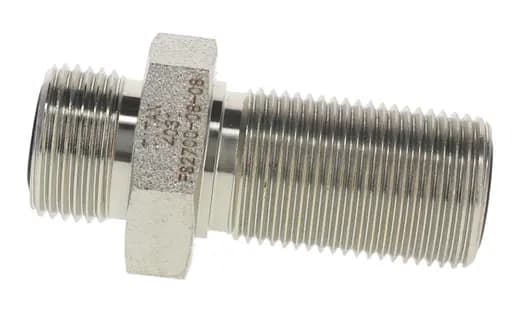
ORFS is the fitting reached for when leakage cannot be tolerated. It seals by pressing an O-ring against a flat, machined face; that face and the O-ring groove therefore determine whether the connection holds. One scratch across the face or a grain of grit in the groove is already enough for a leak, so ORFS protection covers the entire sealing face.
What is an ORFS fitting?
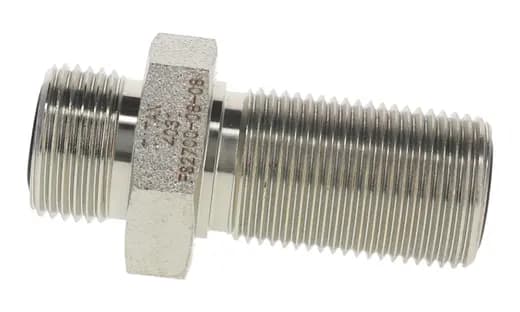
ORFS, or O-Ring Face Seal, is defined in SAE J1453 and was developed for superior leak-tightness in demanding systems. It seals by compressing an O-ring against a flat face and is therefore highly resistant to vibration, pressure peaks and dynamic loads. The straight UNF thread clamps the connection, while the face and the O-ring seal.
How it seals
- Flat, machined sealing face
- O-ring in a groove on the face
- Straight UNF thread for the clamping force
- Excellent resistance to vibration leakage
Where ORFS fittings are used
ORFS is specified where leakage is unacceptable and vibration is high. In construction it keeps the vibration-intensive boom and arm circuits of excavators tight. In mining it carries the high-pressure main lines of dump trucks and drill rigs. In forestry it feeds the shock-loaded actuator lines of harvester heads and cranes, and in recycling it runs the high-pressure press circuits of balers and compactors.
How to check this is your application: if your fitting has a flat sealing face with an O-ring recessed into it (no cone or flare), then ORFS protection is the right family. Choose the cap or cover by thread size.
What the protection must cover
Because the seal is the flat face and its O-ring, you judge the protection on whether that entire face is covered. The risks it protects against:
- Face damage: scratches and dents across the flat sealing face
- Contamination: grit and moisture settling in the O-ring groove
- O-ring loss or damage: the elastomer damaged, aged or pushed out
- Corrosion: moisture attacking the machined face during storage
ORFS at a glance
| Characteristic | Value |
|---|---|
| Standard | SAE J1453 |
| Thread | Straight UNF thread |
| Seal | Flat sealing face with O-ring on the face |
| Strength | Highly resistant to vibration and pressure peaks |
| Sizes | Dash -4 to -24 (tube 1/4" to 1-1/2") |
| Region | Worldwide, heavy-duty systems |
Does this protection suit your application?
Before ordering, check that ORFS protection matches your situation:
- Connection: flat sealing face with O-ring, straight UNF thread
- Size: thread or dash size known and matching
- Environment: high vibration, outdoor or damp storage and transport
- Medium: mineral oil or biodegradable hydraulic fluid
- Phase: production, storage and transport, or service and maintenance
Related guides
Recommended protection
These categories fit ORFS connections:
Frequently asked questions
How does an ORFS fitting seal?
By compressing an O-ring on the fitting face against a flat mating face. The UNF thread clamps the connection, while the face and the O-ring do the sealing.
Where are ORFS fittings used?
On heavy mobile and construction machinery and other high-pressure systems exposed to vibration, where leak prevention is crucial.
What needs protecting on an ORFS connection?
The flat sealing face and the O-ring groove. One scratch on the face or a grain of grit in the groove breaks the seal, so the caps cover the entire face.
Why is ORFS chosen over JIC?
The O-ring absorbs vibration and pressure peaks, making ORFS more resistant to leakage than a metal-to-metal JIC flare on demanding mobile machinery.
How do I get the right protection for an ORFS fitting?
Start with what needs covering on an ORFS fitting: the flat sealing face and the O-ring groove. Choose a cap or cover for your size — the recommended protection above is the starting point. Then request free samples or a quote; our specialists will confirm the exact parts for your application.